

Digital Marketing Agency Near Sangareddy That Turned a Quiet Nature Resort into a Fully Booked Weekend Escape
When people in Hyderabad think about weekend getaways, they often return to the same familiar options. Places like Ananthagiri Hills or resorts along the ORR are easy to recall because they are widely promoted and already part of people’s memory.
But not every meaningful experience is loud or heavily marketed.
There is a quieter side near Sangareddy, around the Manjeera Reservoir, where nature feels closer, space feels open, and time moves differently. It is not crowded, not overly commercial, and not part of the usual list people scroll through.
This is where Margosa Rewild Resort exists not as a mainstream destination, but as a place people discover and then remember.
Why most families never found this place earlier
Before the strategy changed, the challenge was not the resort or its experience. The location already had everything families look for greenery, calm surroundings, and a peaceful environment that feels far from the city without actually being far.
The real problem was visibility in the right moments.
When families searched for “weekend getaway near Hyderabad” or “nature resort close to the city,” the discovery path was dominated by more familiar locations. The Manjeera Reservoir belt was not naturally appearing in those journeys.
At the same time, the resort had only a limited number of rooms. It did not need large volumes of traffic. It needed consistent demand from people who were actually ready to travel families planning short breaks and corporate groups looking for quiet retreats.
What changed when digital marketing became behaviour-driven
The turning point came when the focus shifted from promotion to behaviour.
Families in Hyderabad do not plan long trips every week. Most weekend decisions are quick and emotional, often made between Thursday evening and Friday night. They look for places that feel different, but are still easy to reach.
By understanding this pattern, the positioning of the resort changed.
Instead of being shown as just another resort, it became a natural answer to a specific need a close, peaceful, nature-driven escape that does not require long travel.
The Manjeera Reservoir became part of this story, not as a forced keyword, but as a real-world reference that represents calm surroundings, water, greenery, and open space.
How the experience was communicated in a relatable way
The communication focused on real-life moments instead of features.
Families could imagine children running freely in open areas, parents enjoying quiet evenings, and mornings that feel completely different from city life. The content did not try to sell aggressively. It helped people visualise what their time there would feel like.
This made the resort easier to trust and easier to choose.
How performance marketing supported discovery and intent
The campaigns were designed around how people actually behave online.
Families searching late in the week were shown content that matched their immediate need for a quick getaway. People interested in nature and outdoor experiences were guided toward the resort through visuals that reflected calm, greenery, and simplicity.
Corporate teams were introduced to the resort as a practical option for short offsite gatherings quiet, accessible, and different from typical locations.
Instead of forcing location-based keywords, the strategy connected intent, timing, and experience.
What happened after this approach was implemented
The results were clear and directly connected to business performance.
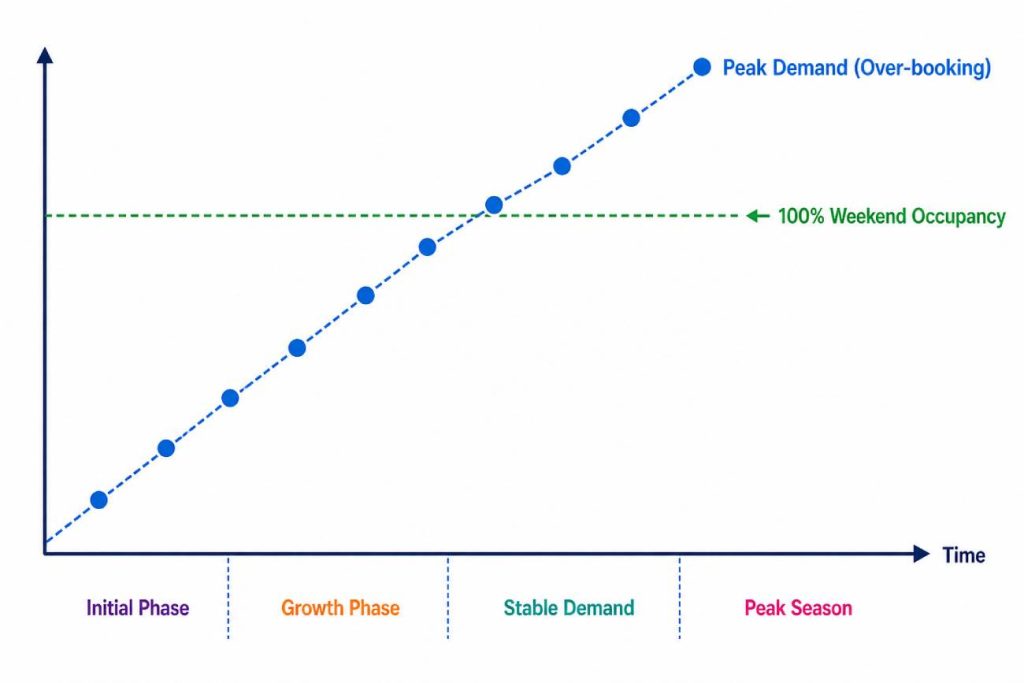
The resort reached 100% weekend occupancy, meaning every available room was consistently booked. This shows that the right audience was being reached at the right time.
During peak seasons, demand went even higher, leading to over-booking situations, where inquiries exceeded room availability. This is a strong indicator of growing demand and high intent.
Corporate interest also improved significantly, with the resort receiving 2 to 3 corporate bookings per week, creating a stable and recurring source of bookings.
At the same time, there was a noticeable increase in organic discovery. More people started searching for terms like “resort near Manjeera Reservoir,” “nature stay Sangareddy,” and “weekend getaway near Hyderabad,” showing improved visibility and stronger geographic association.
Families also began to remember the resort differently not as just another option, but as a specific kind of experience connected to nature and calm.
How demand grew over time
The growth did not happen instantly. It developed gradually as the strategy aligned more closely with real user behaviour.


Line Growth Graph – Booking & Demand Growth
What this growth means in simple terms
At the beginning, visibility was limited, so bookings were inconsistent. As the strategy improved discovery and aligned with how families actually plan trips, bookings started to grow steadily.
This eventually led to full weekend occupancy. Over time, demand became so strong that even limited availability could not match it, resulting in overbooking during peak periods.
At the same time, corporate bookings added consistency, making the overall demand stable and predictable.
Why this worked in the Sangareddy micro-market
Sangareddy is not a typical tourist hotspot. It is a behaviour-driven destination. People choose it because it offers something different space, calm, and accessibility without long travel.
The Manjeera Reservoir strengthens this identity by giving people a clear mental image of nature and openness. By aligning the strategy with this behaviour, the resort became easier to discover without relying on heavy or repetitive keyword usage.
This eventually led to full weekend occupancy. Over time, demand became so strong that even limited availability could not match it, resulting in overbooking during peak periods.
At the same time, corporate bookings added consistency, making the overall demand stable and predictable.
The thinking behind this approach
This approach was built on a simple idea people do not choose based on promotion alone. They choose based on how well something fits into their life.
By focusing on behaviour, timing, and relevance, the strategy created a natural connection between what people were searching for and what the resort offered.
As a digital marketing agency near Sangareddy, Digital Mojo focused on making that connection clear, simple, and easy to act on.
What digital marketing should actually achieve in such locations
Digital marketing in locations like Sangareddy should not just create visibility. It should guide the right audience toward the right decision.
This involves understanding:
- how people search
- when they decide
- what influences their choice
- how to convert interest into bookings
When these elements come together, results become consistent.
Why this approach continues to deliver results
This method works because it follows natural behaviour.
People respond to relevance, not repetition. When something appears at the right time, in the right context, and matches what they are already thinking, it becomes an easy decision.
That is why the demand is not temporary. It continues.
Before you plan your next weekend
If you are still choosing between the same crowded destinations, it might be worth looking beyond what is commonly promoted.
Some places are not widely advertised.
But once you discover them, they become your preferred choice.
Ready to build real discovery and consistent bookings
If your business is visible but not converting, or if demand is inconsistent, the strategy needs to change.
A system based on behaviour, clarity, and real user intent can turn visibility into actual results.

Frequently Asked Questions for this Article
How does a digital marketing agency near Sangareddy help resorts increase bookings consistently?
A digital marketing agency near Sangareddy does not just focus on increasing visibility. The real goal is to connect the resort with people who are already planning a weekend escape or short trip. In locations like Sangareddy, especially around areas like the Manjeera Reservoir, demand is not driven by mass tourism but by intent-based discovery.
This means campaigns are built around how families and corporate teams actually plan trips. Most weekend decisions happen late in the week, often between Thursday evening and Friday night. A strong strategy ensures that the resort appears exactly during this decision window with the right message.
Instead of promoting features like rooms or amenities, the communication focuses on experience. It helps users imagine what their weekend will feel like. This shift from promotion to perception is what improves bookings. When visibility aligns with intent and timing, demand becomes consistent rather than seasonal.
Why do many resorts near Hyderabad struggle with visibility despite having good locations?
Many resorts near Hyderabad, including those around Sangareddy, struggle because they are not visible at the right moment in the user journey. Even if the location is strong and the experience is good, users often discover only the most commonly marketed places.
Search behavior plays a big role here. When users search for “weekend getaway near Hyderabad,” they are influenced by familiarity and repeated exposure. If a resort does not appear in that discovery flow, it is simply overlooked.
Another issue is messaging. Many resorts focus on describing what they offer instead of helping users understand how it fits into their lifestyle. Without this connection, even a strong property can fail to convert attention into bookings.
The problem is not the product. It is the positioning and timing of visibility.
How does behaviour-driven digital marketing improve resort occupancy?
Behaviour-driven digital marketing focuses on understanding how users think, search, and decide. Instead of targeting everyone, it identifies specific audience patterns.
For example, families planning weekend trips usually look for quick, peaceful, and accessible options. Corporate teams look for locations that are practical for short offsite meetings. These behaviours are different, and the messaging must reflect that.
When campaigns are aligned with these patterns, the resort becomes a natural option instead of just another listing. This increases the chances of bookings without increasing unnecessary traffic.
In the case of Sangareddy, this approach led to consistent demand and eventually full weekend occupancy. The improvement did not come from more ads, but from better alignment with real user behaviour.
What role does location like Manjeera Reservoir play in digital marketing strategy?
Location plays a psychological role in how users perceive a destination. The Manjeera Reservoir is not just a geographic reference. It represents calm, nature, and openness.
When used correctly in digital marketing, it helps users form a mental image. Instead of reading about a resort, they start imagining a peaceful environment near water, surrounded by greenery.
This makes the experience easier to understand and more appealing.
However, the key is not to force the location as a keyword but to naturally integrate it into the story. When users associate the resort with a real-world reference, it improves both recall and trust.
How does digital marketing convert interest into actual bookings for resorts?
Interest alone does not lead to bookings. The transition from interest to action depends on clarity, timing, and relevance.
Users first discover the resort through search or social media. At this stage, they are exploring options. As they engage further, they need content that helps them visualize their experience. This could include images, short videos, or simple descriptions of what their stay would feel like.
If the messaging remains consistent and relatable, the decision becomes easier.
Retargeting also plays an important role. Many users do not book immediately. Showing them relevant content again helps bring them back when they are ready.
When all these elements work together, interest turns into bookings naturally.
How long does it take to achieve consistent bookings through digital marketing?
The timeline depends on how quickly the strategy aligns with user behaviour. In most cases, initial improvements can be seen within a few weeks, especially in visibility and enquiry volume.
However, consistent bookings, especially something like full weekend occupancy, develop over time. As the system improves, the demand becomes more stable.
In the Sangareddy case, the growth followed a gradual pattern. It started with better visibility, then improved enquiries, and eventually led to consistent bookings and even overbooking during peak seasons.
This shows that sustainable results come from alignment, not instant scaling.
